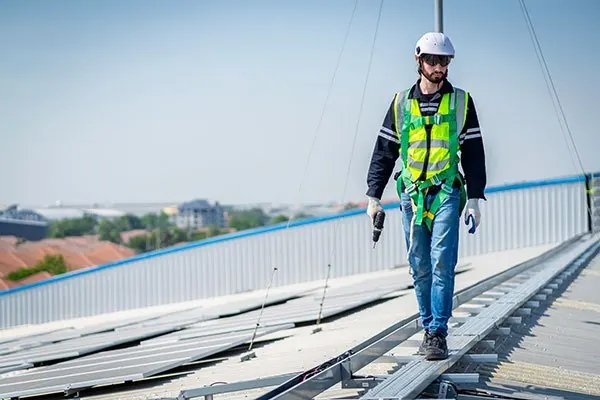
Metal roof replacement, defined
Metal roof replacement means removing an old steel roof, whether galvanised iron, zincalume or pre-painted, and installing new sheeting, fasteners, flashings and usually gutters. It is arranged across Newcastle and Lake Macquarie through independent local roofing contractors, with a free on-site inspection and an itemised quote.
Reading a rusting roof
Not all rust means replacement. Contractors generally look for:
- White powder on zinc-coated steel: early coating loss, not yet structural
- Red rust spots at fixings and laps: localised, sometimes repairable
- Rust streaks running down sheets from laps: the coating has gone at the overlap
- Holes or thinning you can see daylight through from the roof space: replacement territory
- Rusted gutters and valleys, which often fail before the sheets
The roof space tells the story as clearly as the top surface. Daylight through laps, stained battens and rust flakes on the insulation all point to sheeting at the end of its life.
Coastal exposure and grade
Newcastle is a coastal city with an industrial port. Houses near the beaches at Merewether, Bar Beach and Stockton, and properties along the harbour, live with salt and airborne grime. Steel manufacturers grade their products by environment, and their warranties can depend on using the right grade at the right distance from the coast. Ask each contractor which grade they are quoting and why, and make sure screws, rivets and flashings are matched.
Unpainted zinc-aluminium coated steel is cost-effective inland, but near the surf a painted coastal product, or a stainless or aluminium option in very severe exposure, may be specified. Our Colorbond vs Zincalume guide sets out the trade-offs.
Profiles and pitch
Corrugated suits most houses and nearly any pitch above its minimum. Trapezoidal or ribbed profiles carry water on lower pitches and longer spans, and are common on skillion roofs, extensions and commercial buildings. Each profile has a minimum pitch set by the manufacturer. On low-slope roofs, getting that wrong produces leaks no amount of sealant fixes.
Things done right on a good metal roof
- Sheets laid so laps face away from the prevailing weather
- Swarf swept off at the end of every day
- Fasteners in the right number and pattern for the wind exposure
- Flashings turned up and stop-ended so water cannot be driven uphill
- No dissimilar metals touching or draining onto each other, such as copper onto zinc-coated steel
- Gutters sized for Newcastle's heavy downpours, with overflow provision
Old galvanised iron roofs
Many older Newcastle houses still carry galvanised corrugated iron, sometimes the original roof, sometimes a mid-century replacement. These roofs can last a long time inland, but by now most are well past their best: the zinc has gone, rust has taken hold at nail holes and laps, and the roof has usually been patched and painted several times. Paint over rust hides the problem rather than fixing it.
When these roofs come off, contractors commonly find hardwood battens nailed rather than screwed, no sarking, and timber that needs attention around old leaks. Replacing them with modern steel is often the moment to bring the whole roof up to current practice: screwed battens, a blanket, proper flashings and gutters sized for today's downpours.
Partial replacement on the weather side
Because coastal corrosion is uneven, it is sometimes possible to replace only the worst faces of a steel roof, usually those facing the ocean or the prevailing weather. That can make sense where the remaining faces are genuinely sound. Ask the contractor to show you the condition of each face before deciding.
Before you sign
Check the contractor's NSW Fair Trading licence, ask what insurance they carry, and get the scope in writing. Our guide to choosing a roofing contractor in Newcastle has a checklist. Planning prices are on the 2026 cost page.